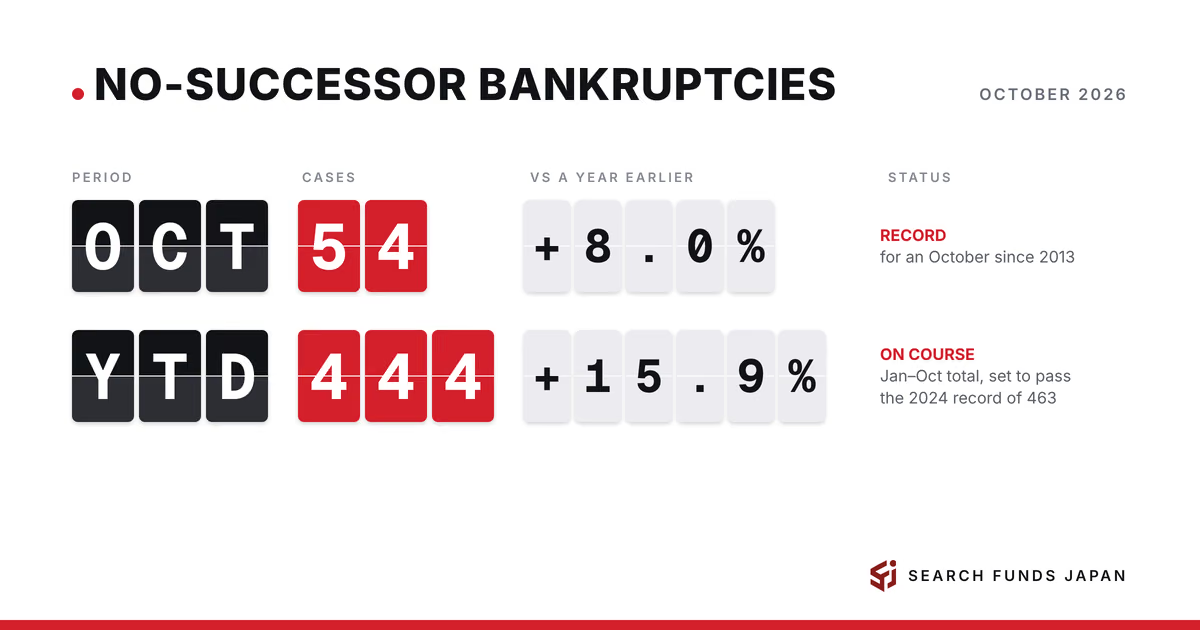
More Japanese companies are going under with no one lined up to take over, and this year is on course for a record. Tokyo Shoko Research (TSR) counted 54 bankruptcies in October in which the lack of a successor played a part, up 8.0% on a year earlier. That is the most for any October since its records began in 2013 and the highest month of 2026 so far. Only two months have been busier, both in the spring of 2024. TSR counts only failures with debts of ¥10 million or more.
January to October now stands at 444, up 15.9% on the same months of 2025. The full-year high is 463, set in 2024, and TSR says it is certain to be broken. On our arithmetic, 20 more cases in November and December would do it, fewer than any single month has produced this year.

How these companies ended
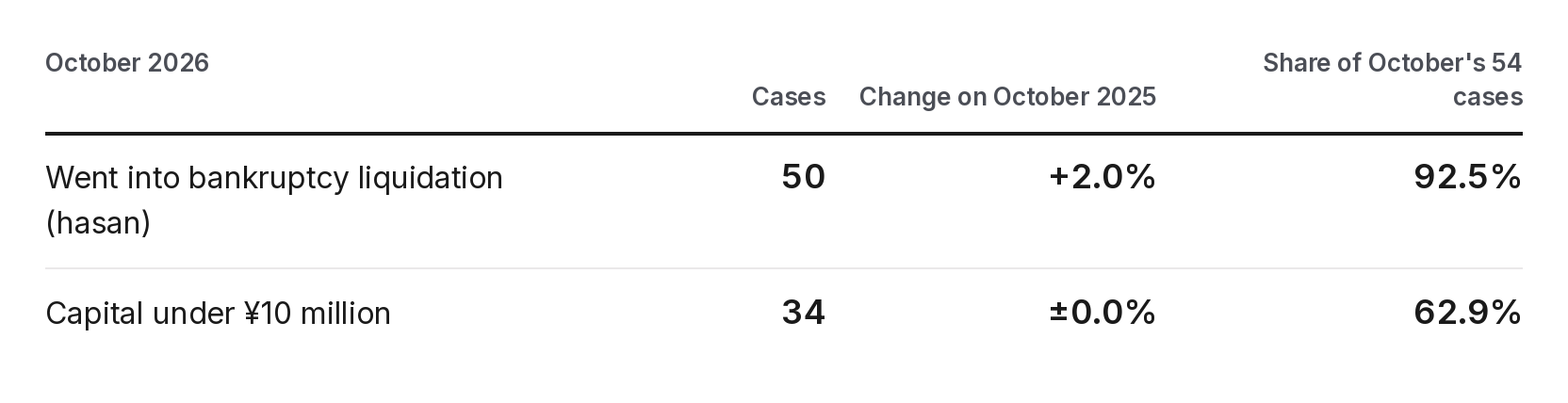
The form of failure matters more than the count. Nearly every case went into hasan, Japan’s court-run liquidation, in which a trustee sells the company’s assets to repay creditors. TSR says this shows how hard it is to rebuild a company that has no successor.
Most were small. Companies with capital under ¥10 million, which TSR describes as small and micro businesses, made up the majority, the same number as a year earlier. TSR’s explanation is practical: firms already short of staff and cash rarely get as far as training a successor or planning a handover.
Why having no successor is so risky
TSR’s starting point is blunt: companies with no successor are finding it harder to survive. It points to the banks. Lenders are tightening credit to companies that cannot show a long-term plan, and a business that is shrinking year after year finds it hard to raise money.
The trigger is usually personal. In TSR’s count for April to September, the death or ill health of the person running the company lay behind 85.5% of cases. We covered those six months in our piece on the fiscal first-half record.
Teikoku Databank, which collects and classifies these cases its own way, found 49 in October, up from 41 a year earlier, with the owner’s illness or death the main cause in 28. Its definitions differ from TSR’s, so the two series are best read side by side. Both rose in October.
What it means for buyers
By the time a company goes into bankruptcy, its options for a handover may already have narrowed. The bankruptcy count also says nothing about whether any of these owners tried to sell.
The signal for acquirers sits earlier. TSR’s 2026 succession survey found that a third of companies run by someone in their 70s (32.98%) still had no successor lined up. Read alongside the health figures above, that leaves many companies resting on one person staying well. TSR’s own prescription is support from banks and funds, bringing in people from outside, and help for owners who decide to close. In February 2025 it listed search funds among the succession options now emerging. The useful window for an outside successor is before the owner’s health gives out, while the company still has customers, staff and a lender willing to stay.
Sources
- Tokyo Shoko Research: “Successor shortage” bankruptcies, October 2026 (7 Nov 2026) (retrieved 2026-11-17)
- Tokyo Shoko Research: “Successor shortage” bankruptcies, fiscal first half of 2026 (6 Oct 2026) (retrieved 2026-11-17)
- Tokyo Shoko Research: “Successor shortage” bankruptcies, January 2025 (11 Feb 2025) (retrieved 2026-11-17)
- Tokyo Shoko Research: 2026 successor absence rate survey (12 Nov 2026) (retrieved 2026-11-17)
- Teikoku Databank: National bankruptcy tally, October 2026 (10 Nov 2026) (retrieved 2026-11-17)