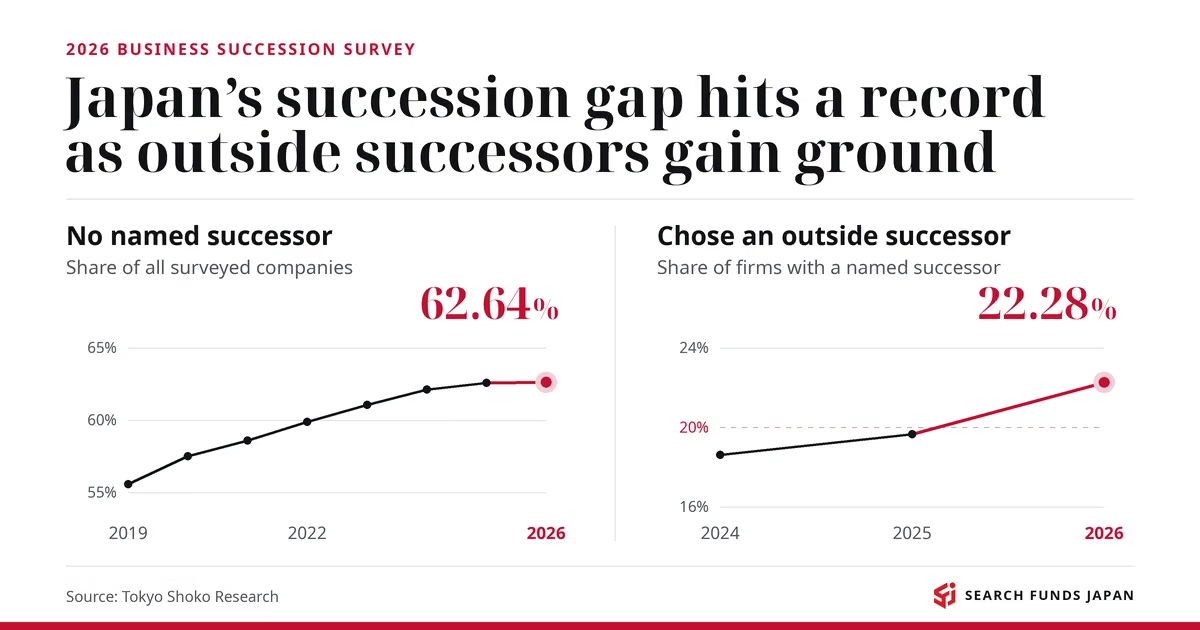
More Japanese owners are choosing a successor from outside the company. In Tokyo Shoko Research's (TSR) 2026 survey, published on 12 November, 14,624 of the 65,651 companies with a named successor chose an outsider: 22.28%, up from 19.67% in 2025. Among companies still without a successor, though, a sale is a rare plan.
For a searcher, three questions stand out: where the owners without a successor are, who is open to an outsider, and how many plan to sell.
Where the owners without a successor are
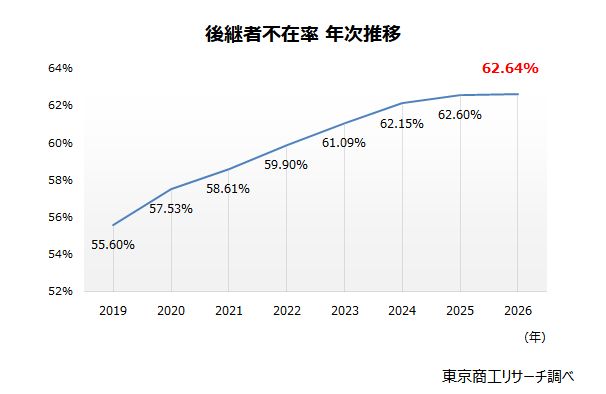
Of the 175,763 companies TSR studied, all with succession records from 2024 onwards, 110,112 had no successor. That is the highest share since the survey began in 2019, but it rose only 0.04 points on the year. TSR moves the starting year for those records forward with each survey, so the chart below follows slightly different groups of companies.

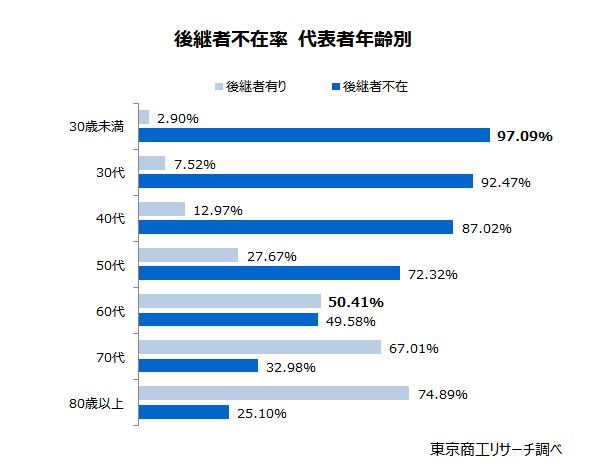
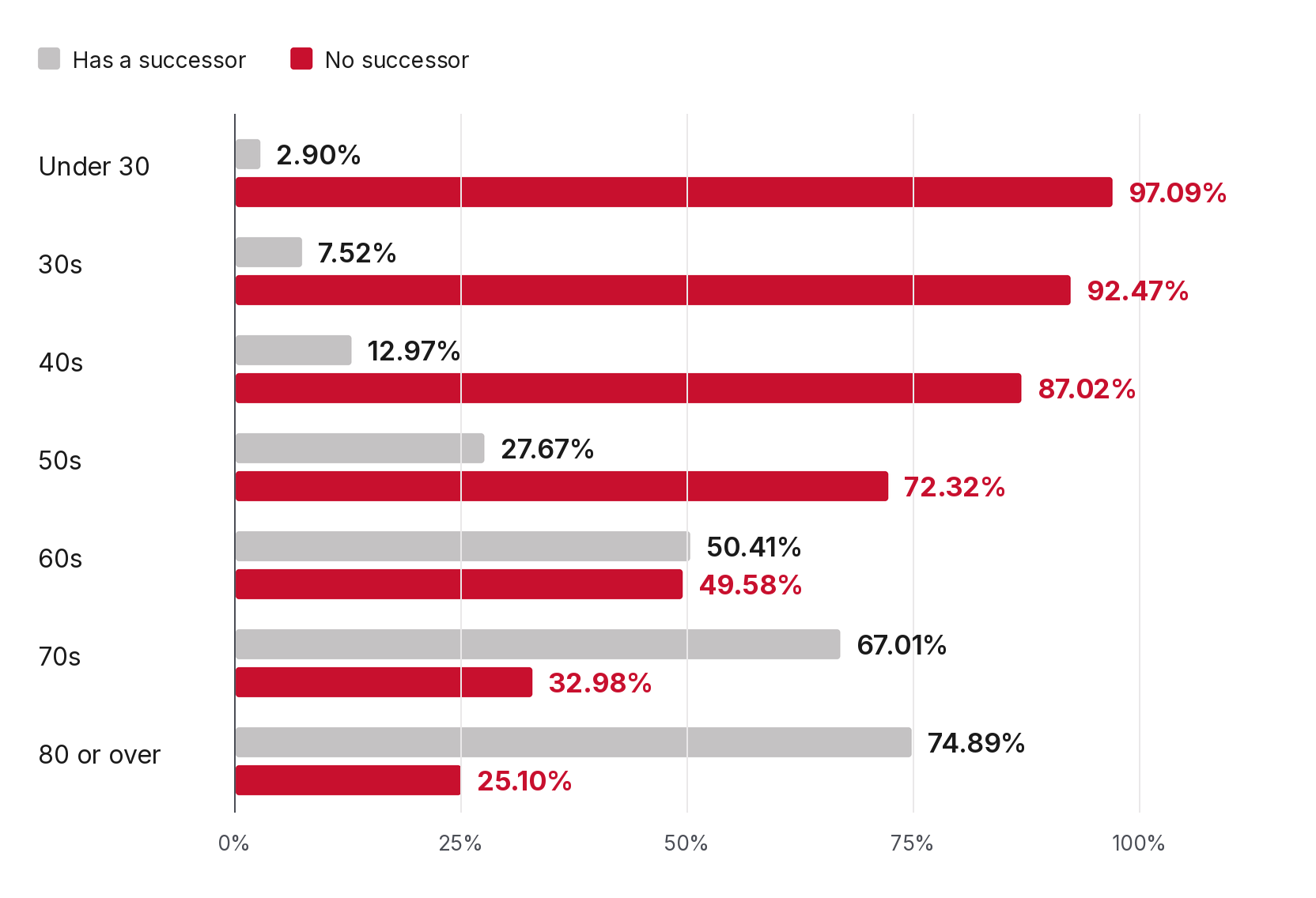
Age tells a sharper story than the headline rate. TSR says the youngest heads, having only recently founded or taken over their companies, have not yet needed to choose a successor. From the 60s onwards, companies with a successor outnumber those without. Even so, about one in three companies run by someone in their 70s, and one in four whose head is 80 or over, have nobody lined up, and both shares rose on the year. Given how long a smooth handover takes, TSR expects some of these companies to leave the market.
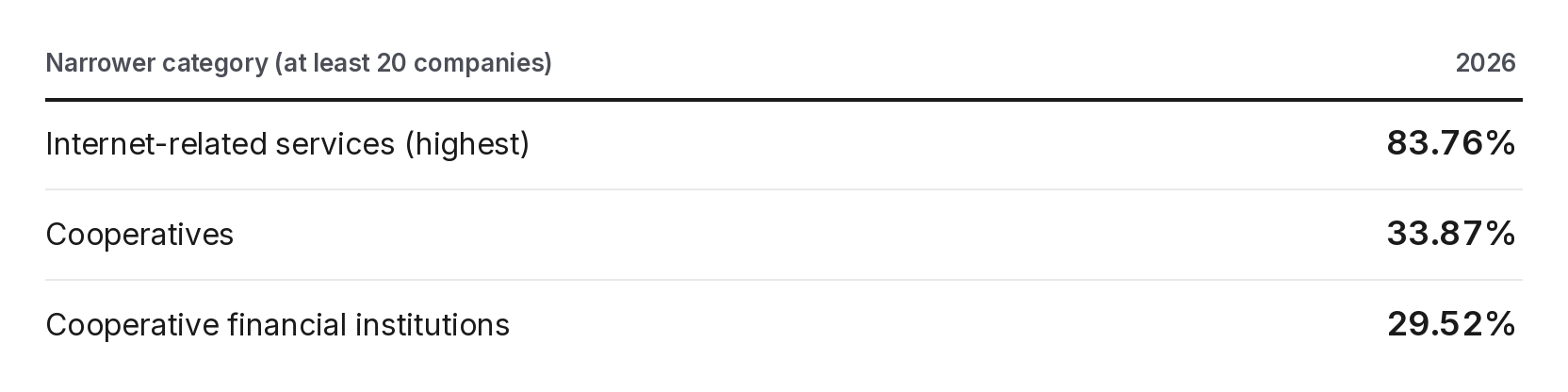
Industries vary widely. Across TSR's ten broad industries, information and communications still has the highest rate, though it eased on the year, and real estate dropped below 60%, leaving five industries above that level. Among narrower categories, internet-related services come top, at nearly three times the rate of cooperative financial institutions, one of the lowest. Online and other non-store retail, and professional services such as licensed practices and management consultancies, also sit near the top. TSR suggests that where earnings rest on the owner's own judgement, qualifications or skills, the company itself may not be seen as something to hand on. For a buyer, the question is how much of the business depends on the current owner's skills or qualifications.

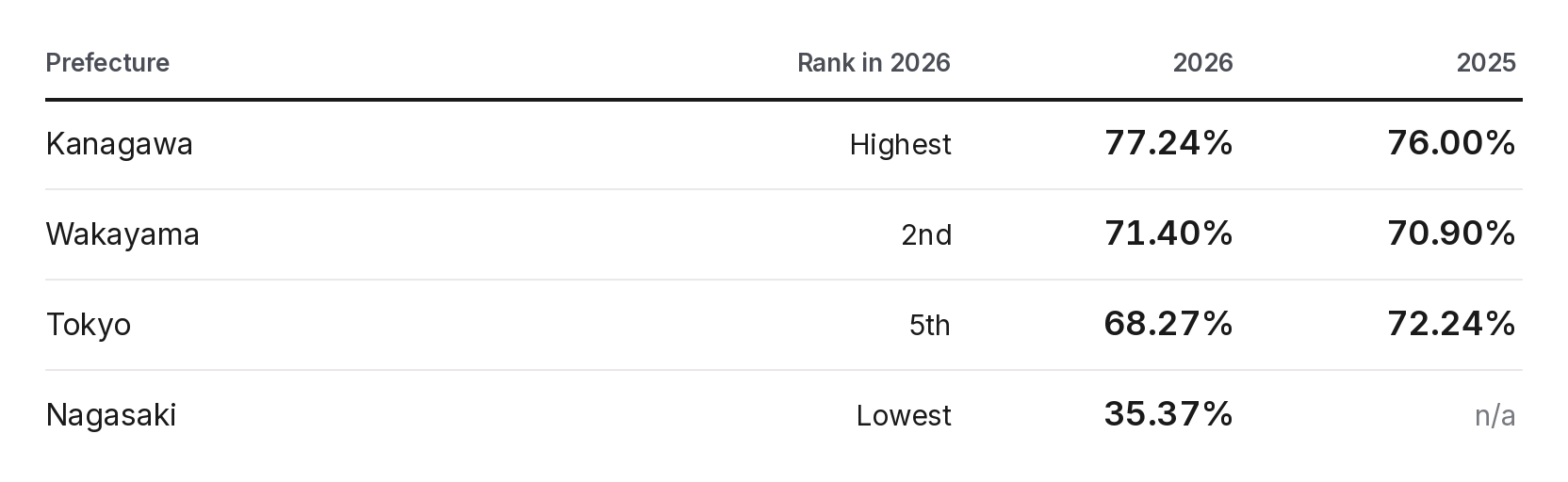
Prefectures differ just as sharply. Kanagawa's rate is more than double that of Nagasaki, the only prefecture below 40%, and 25 prefectures are above 60%. Tokyo's rate fell, taking it from second to fifth. The capital subsidises share valuations, due diligence and specialist fees, and in June 2025 launched a programme to help successors grow the businesses they take over. TSR suggests this support may be encouraging owners and would-be successors to act.
Who is open to an outsider
Family succession is still the norm, but it has lost a little ground each year. Since 2024 the share of named successors from outside the company has risen by 3.65 points, while the family share has fallen by 3.37. TSR sorts successors into family members, employees promoted from within, and people brought in from outside the company. Its 2026 release gives only the family and outside shares. In 2025, internal promotion was almost unchanged while outside hires grew, and TSR remarked that the door to a company's own staff remained narrow.

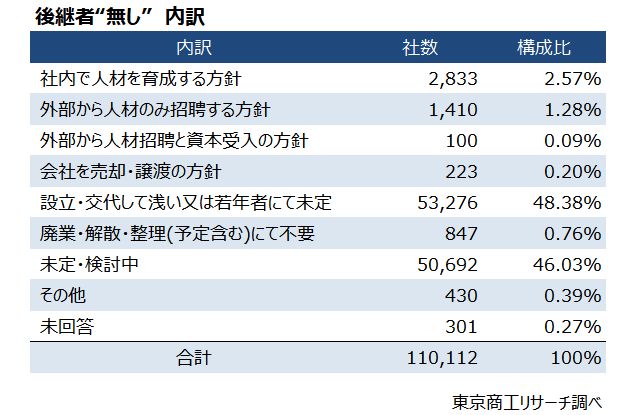
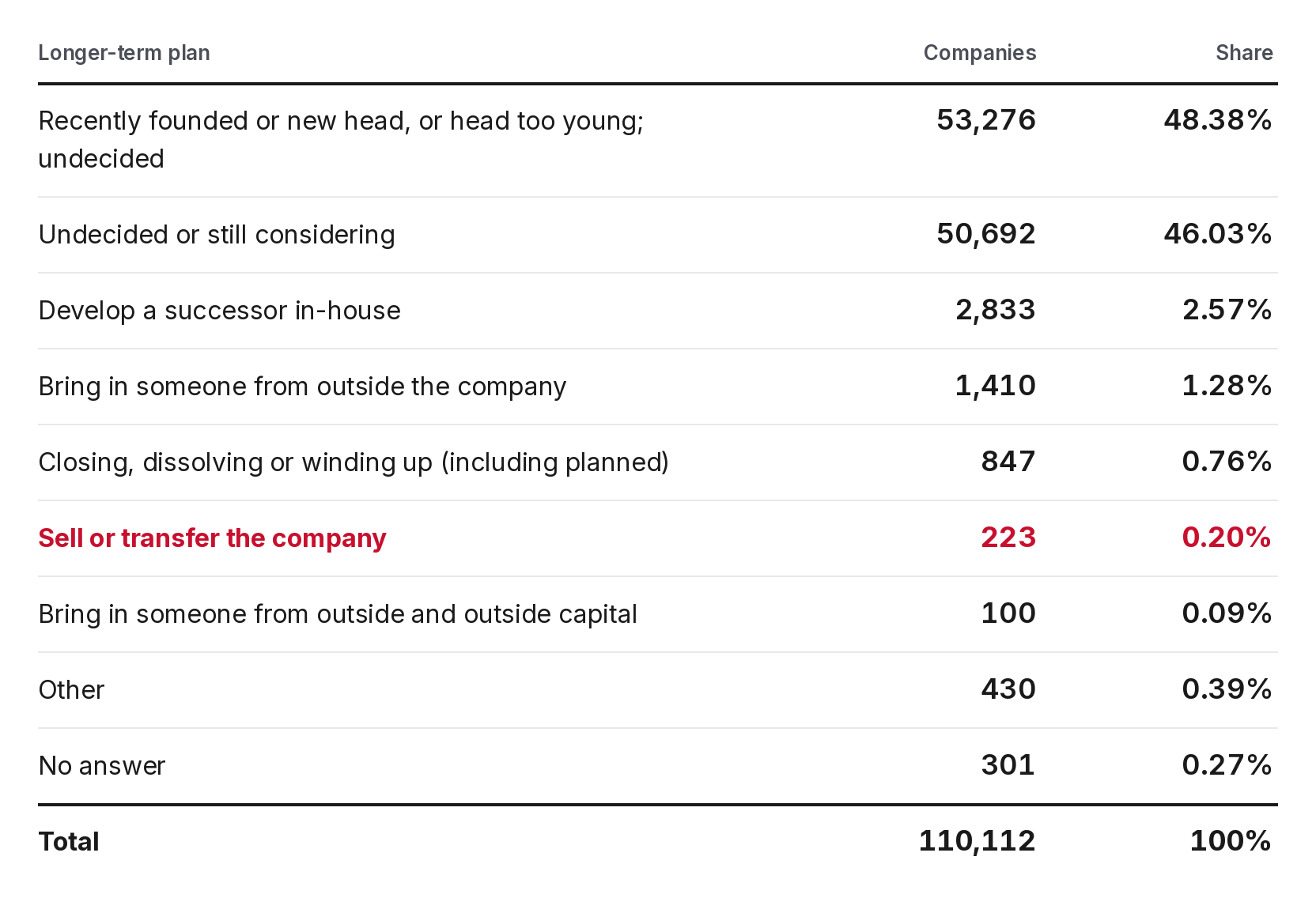
The same openness shows up, faintly, among companies with no successor. Some 1,410 plan to bring in someone from outside the company, and another 100 plan to bring in an outsider and outside capital together.
How many plan to sell?
Very few. Of the companies without a successor, 223 plan to sell or transfer the company. Almost four times as many say they need no successor because they are closing, dissolving or winding up, or plan to, and more than six times as many plan to bring in someone from outside the company. Nearly all the rest are undecided, because the company is new or has a new head, because the head is young, or because they are still considering.
Where search funds fit
A family can appoint an outside chief executive and keep its shares. In a search fund, an entrepreneur backed by investors buys the company and runs it, so ownership and management change hands together. The Search Fund Association of Japan's first survey of the sector, released on 6 November, counted 17 acquisitions by the entrepreneurs who responded, 47% of them outside Greater Tokyo.
Our view
The views below are ours. Among companies that have named a successor, outsiders are gaining ground. Among those still without one, bringing in someone from outside the company was a more common plan than selling or transferring it, and so was closing down. For a searcher, that makes the handover itself a good place to start: who the owner wants to run the business, what role they would like to keep, and whether they would consider a change in ownership.
Sources
- Tokyo Shoko Research, 2026 successor survey (published 12 November 2026; accessed 15 November 2026)
- TSR chart, companies without a successor by plan
- TSR chart, successor status by age of company head
- TSR chart, no-successor rate 2019 to 2026
- Tokyo Shoko Research, 2025 successor survey (published 10 November 2025; accessed 15 November 2026)
- TSR chart, industries and successor split 2025
- Tokyo Shoko Research, 2024 successor survey (published 8 November 2024; accessed 15 November 2026)
- Tokyo Metropolitan Government, 「ツギノツギ」 project launch (25 June 2025; accessed 15 November 2026)
- Search Fund Association of Japan, Search Funds Study in Japan 2026 (published 6 November 2026; accessed 14 November 2026)