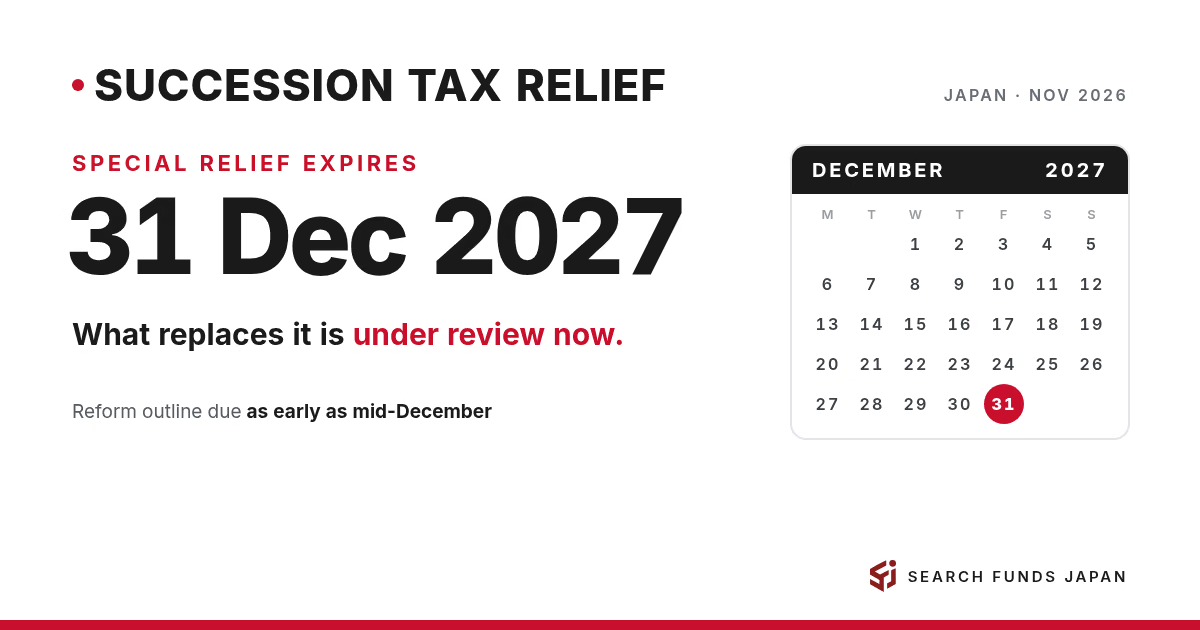
The application period for the special measure in Japan's corporate succession tax system closes at the end of 2027. On 6 November 2026 the Small and Medium Enterprise Agency published the report of its study group on intra-family succession, which sets out what should come after it.
The measure defers gift and inheritance tax when a successor receives unlisted shares as a gift or an inheritance. A buyer who pays for the shares gets nothing from it, and for search funders that is the detail to keep in mind. As we set out earlier this month, a special succession plan can still be filed until 30 September 2027, and the gift or inheritance itself has to happen by 31 December 2027. That second deadline has not moved. For gifts and inheritances made by then, the deferral carries on after that date for as long as the conditions are met, such as holding on to the shares.
A deferral for gifts and inheritances
The special measure arrived in the FY2018 tax reform as a ten-year expansion of the general measure, which has no end date. It lets a successor defer all of the gift or inheritance tax on every voting share. The general measure stops at two-thirds of the shares and defers only 80% of inheritance tax. The special rules also allow up to three successors and relax the employment condition.
The study group, chaired by University of Tokyo economics professor Noriyuki Yanagawa, met six times between June 2025 and August 2026. The ruling parties' FY2026 tax outline had already said the future of the measure would be settled in the FY2027 reform.
How widely it is used
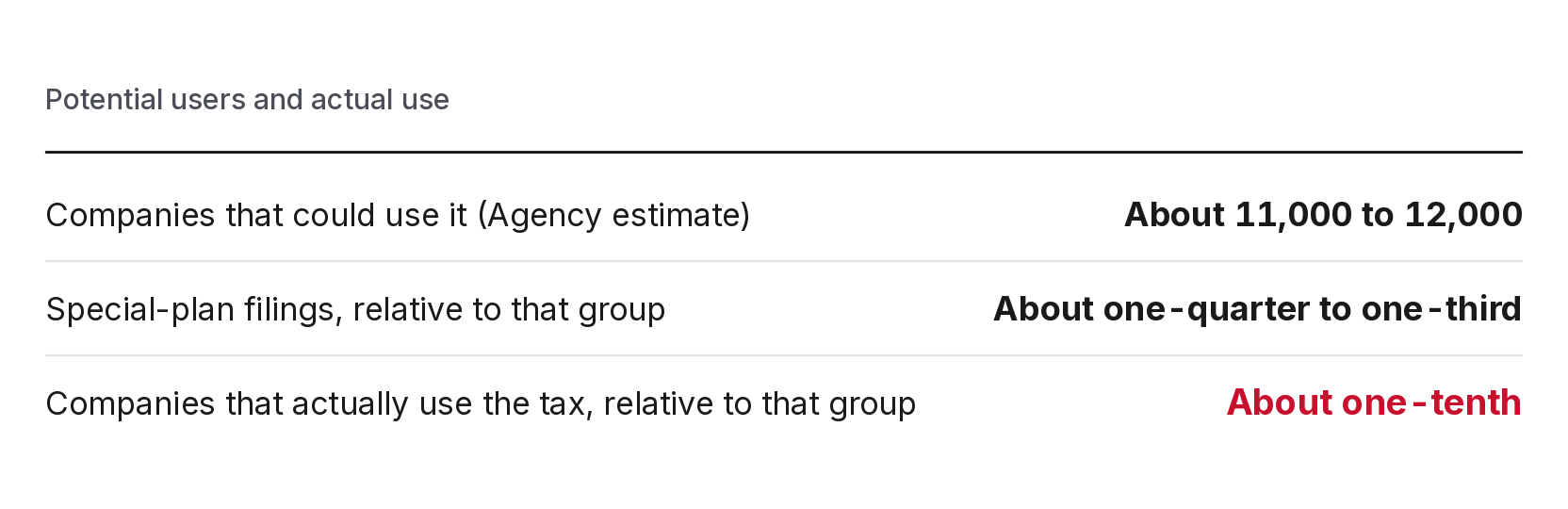
The Agency estimates a wide gap between the firms that could use the measure and those that actually do.
The Ministry of Economy, Trade and Industry's FY2027 tax request, drafted by the Agency, counts special-plan filings year by year. They surged once the measure began, held roughly flat for a few years and jumped in FY2023, before the filing deadline was pushed back again. They dropped sharply the following year and picked up in FY2025.

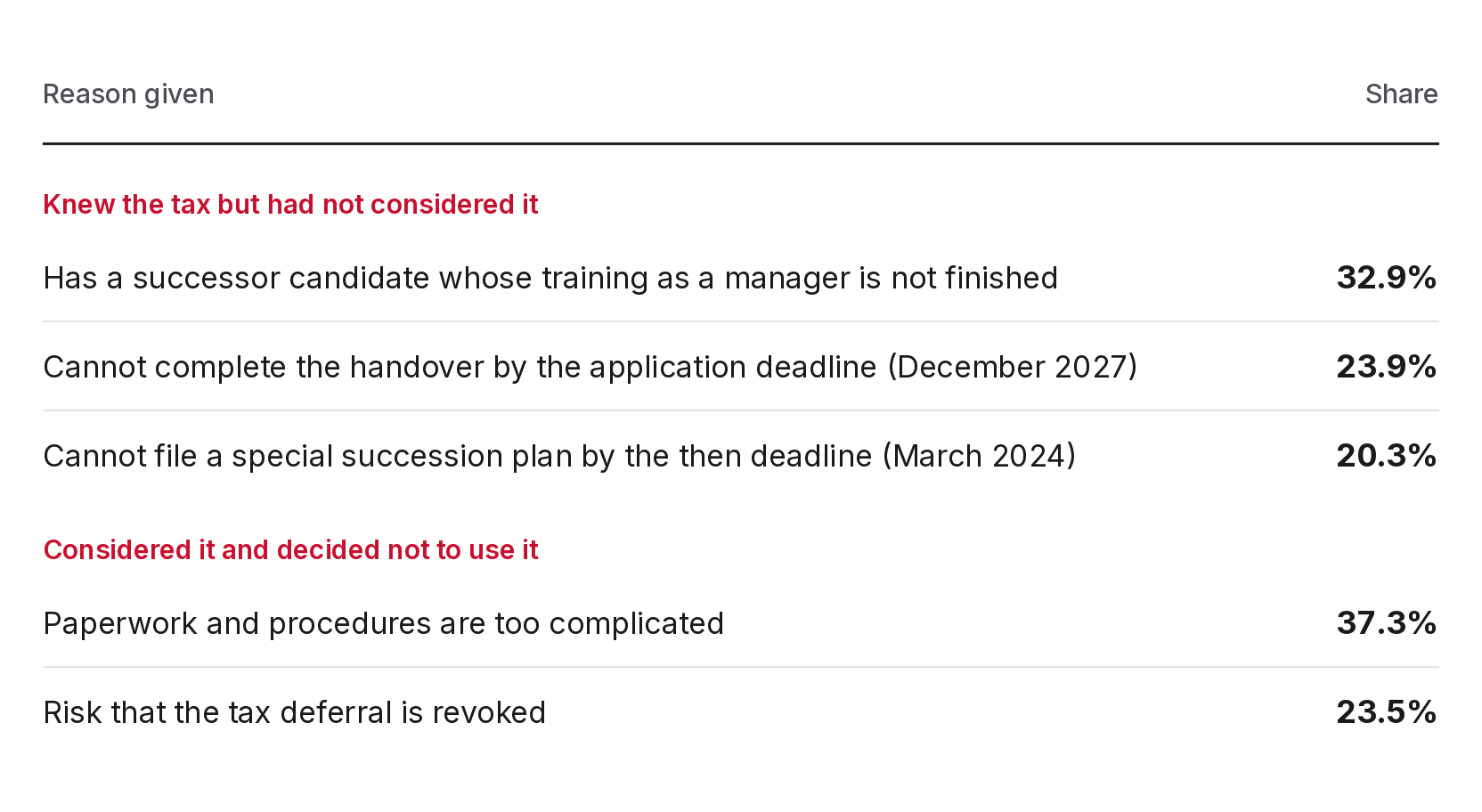
The Agency's survey figures come from a 2023 Tokyo Chamber of Commerce and Industry survey of firms mainly in Tokyo's 23 wards. Among those with a successor or successor candidate, 39.6% said they were unaware of the relief. Firms that knew it but had not considered it often pointed to a successor candidate still being trained as a manager, or to deadlines they did not expect to meet. Firms that considered it and decided against using it cited hurdles in the rules, such as the paperwork and the risk of the deferral being revoked.
The report credits the special measure with helping some owners hand over earlier, and notes that special plans are filed all over the country while M&A deals cluster in the cities. Even so, it concludes that the effect fell short of what was hoped. Owners aged 70 and over are still a large share, and plenty in their 60s have yet to hand over.
What the study group wants the reform to consider
The report wants a tax that does more to bring succession forward and that more businesses use. Most of its specific ideas are framed as questions for the design work ahead. METI's FY2027 request already asks for a "fundamental review and strengthening" of the measure, and leaves the length of any new measure open.
The group doubts that a fixed two-thirds cap should return, noting that the limit helped hold back the general measure. It wants the new design to centre on planned gifts. Among companies using the special measure, those handed over by gift saw faster sales growth than those passed on by inheritance, with the gap showing from the first year. About six in ten gift handovers came at least half a year after the special succession plan was filed.
The length of the deferral is another problem. After five years of continued business it runs on for as long as the successor holds the shares, ending only when an exemption applies, such as a gift of the shares to the next successor, or when the tax falls due. That puts some owners off. The long deferral can also push companies into share-price tactics that do nothing for growth, and leaves successors worrying about the cash they would need if the deferred tax fell due. For firms that meet extra conditions, the group suggests looking at a valuation cut or forgiving the deferred tax, with caps and anti-avoidance rules.
The headcount-based employment test may not suit a shrinking workforce, and the report floats a benchmark or a test based on productivity or pay. Shares in overseas subsidiaries, the number of successors allowed and lighter reporting to prefectures and tax offices are also on the list.
Unlisted share values, in the same reform
The same tax season will also take up how unlisted shares are valued for inheritance tax. A National Tax Agency expert panel has been meeting on the question since April 2026. Some study-group members worried that if valuation stops making allowance for succession, the succession tax alone may not absorb the burden.
On 16 November, after an informal meeting of senior members of the Liberal Democratic Party's Research Commission on the Tax System, its chairman Itsunori Onodera told reporters that "there were no opinions in support" of the National Tax Agency's proposal and that the issue would be discussed "from a clean slate". Jiji and NHK both reported that he would not use the agency's plan as the starting point. According to Jiji, the commission aims to agree the FY2027 tax outline with its coalition partner's tax panel as early as mid-December.
What we take from it
A searcher or any other buyer who pays for the shares gets no deferral, while a gift to an employee successor can qualify. That tilts the tax sums towards keeping a company in the family or handing it to staff. The tilt would grow if the new design makes planned gifts easier or adds an exemption or valuation cut for some firms.
If the special measure lapses and only the narrower general measure is left, some family handovers that depend on a full deferral would be harder to complete, and a few more owners might look at a sale. Sale intentions start from a low base, though. In Tokyo Shoko Research's latest successor survey, very few companies without a successor said they planned to sell. In a Japan Chamber of Commerce and Industry survey, most owners aged 60 and over who wanted to carry on without a successor had never considered M&A.
For now, the 2027 deadlines stand. Owners who mean to use the special measure still have a plan to file, and the gift or inheritance has to take place by the deadline, so buyers talking to those companies should expect that route to be on the table alongside any sale.
Sources
- Small and Medium Enterprise Agency, Report of the study group on intra-family succession of SMEs (6 November 2026)
- Small and Medium Enterprise Agency, Study groups (kenkyukai) index
- Small and Medium Enterprise Agency, Interim summary of the study group on intra-family succession of SMEs, reference material (December 2025), p. 14
- Small and Medium Enterprise Agency, Study group, 4th meeting, document 3: direction of the business succession tax system, p. 8
- Tokyo Chamber of Commerce and Industry, Results of the survey on business succession (29 February 2024)
- National Tax Agency, Outline of the gift and inheritance tax deferral and exemption for unlisted shares (corporate business succession tax system) (July 2026)
- Ministry of Economy, Trade and Industry, FY2027 tax reform request: fundamental review of the business succession tax system
- Jiji, LDP tax commission: no support for the National Tax Agency's unlisted-share valuation plan (16 November 2026)
- NHK, Onodera: the National Tax Agency plan will not be the starting point (17 November 2026)