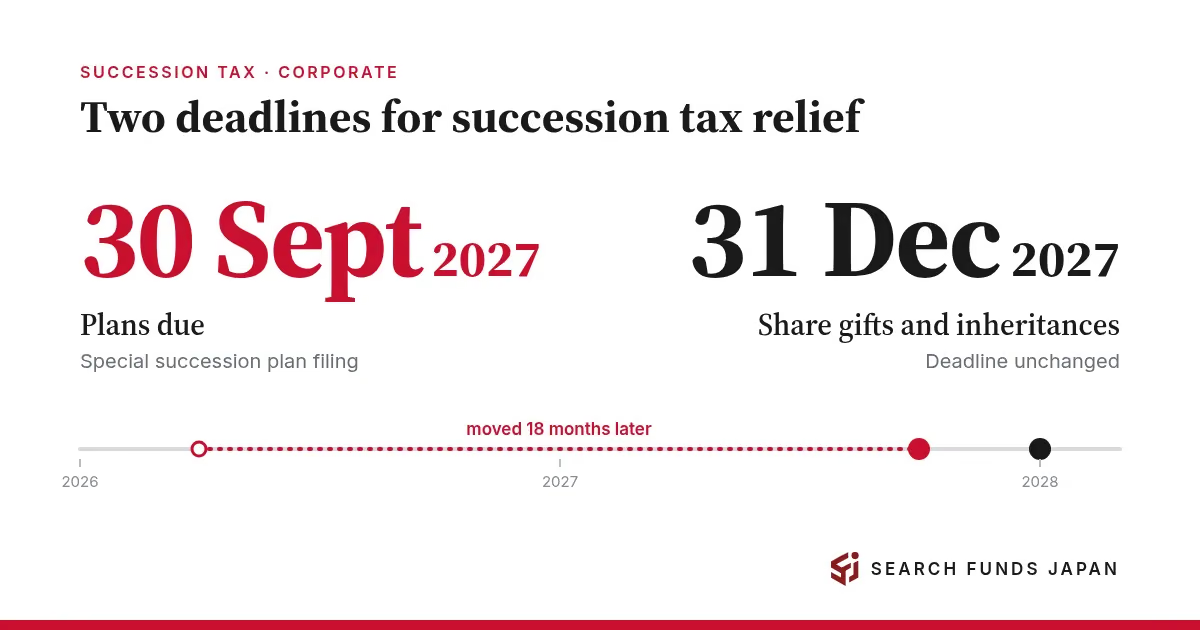
The deadline to file a special succession plan under Japan's corporate succession tax measure is now 30 September 2027, 18 months later than before. Gifts or inheritances of shares must still take place by 31 December 2027. Both dates appear in a Ministry of Finance briefing of 9 October 2026 for the tax-policy evidence panel, and in the National Tax Agency's July 2026 leaflet.
What changed
- December 2024: the ruling parties' FY2025 tax outline revised the officer-appointment requirement and said the measure's deadline would not be extended again (MOF briefing).
- December 2025: the FY2026 outline extended the corporate plan deadline by 18 months, to end-September 2027, and the individual-business plan deadline by 30 months, to end-September 2028. The rule amendment took effect on 1 April 2026 (Miyagi, Kanagawa).
- The same outline says the ruling parties will reach a conclusion on what follows the deadlines in the FY2027 tax reform, after weighing concerns about stalled generational change and regional growth alongside how the measure has been used and fairness of taxation.
The rules in brief
- The special measure can defer 100% of the gift or inheritance tax attributable to all the unlisted shares acquired that carry full voting rights. The general measure covers at most two-thirds of the shares, and defers 100% of gift tax but only 80% of inheritance tax (NTA leaflet).
- Up to three successors can receive shares from several shareholders, and the employment requirement (80% on average over five years) is relaxed (NTA leaflet).
- The order: the company files its plan with the prefecture, the shares pass by gift or inheritance, the company applies to the prefecture for certification (for a gift, from 15 October of that year, or the gift date if later, to 15 January of the following year; for an inheritance, between five and eight months after the death), and the successor files the tax return with the certificate and security (gifts 1 February to 15 March of the following year, inheritances within 10 months). The plan can go in with the certification application, but only up to the plan deadline. For any gift made in 2027, or an inheritance from May 2027, the certification window opens after that deadline, so the plan has to go in on its own, ahead of the application.
- Deferral is not exemption: tax is forgiven on events such as a successor's death, and falls due with interest tax if requirements are broken. For the first five years, an annual report goes to the prefecture and a continuation filing to the tax office; after that, the continuation filing goes to the tax office every three years. If the owner who gave the shares dies while the gift tax is still deferred, the deferred gift tax is forgiven and the shares are treated as inherited at their value when given. To defer the inheritance tax on them, the company must apply to the prefecture within eight months from the day after the death (Kanagawa).
- The individual-business version covers gifts and inheritances up to 31 December 2028 (NTA leaflet).
What the Ministry of Finance data shows
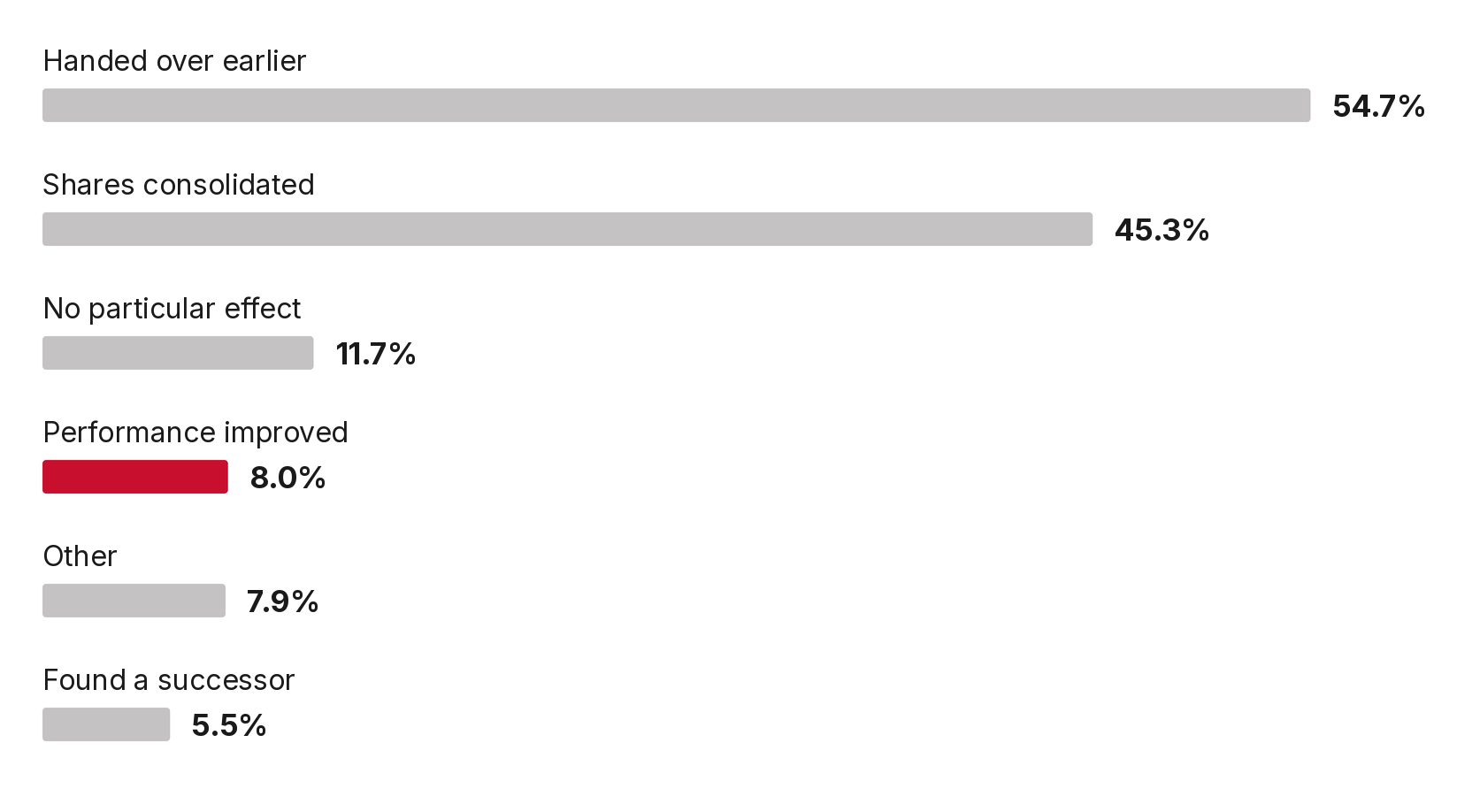
The briefing counts about 13,000 inheritances a year of shares in family-controlled companies (2024 returns), a count that also takes in large-company and minority holdings outside the measure. About 80% involve shares worth ¥70 million or less, and use of the measure there is under 3%. In an SME Agency survey of 1,736 users (June 2025), 54.7% said it let them hand over earlier and 45.3% said it consolidated shareholdings; 8.0% said performance improved. The Ministry concludes it is unclear whether the measure raised growth or productivity.
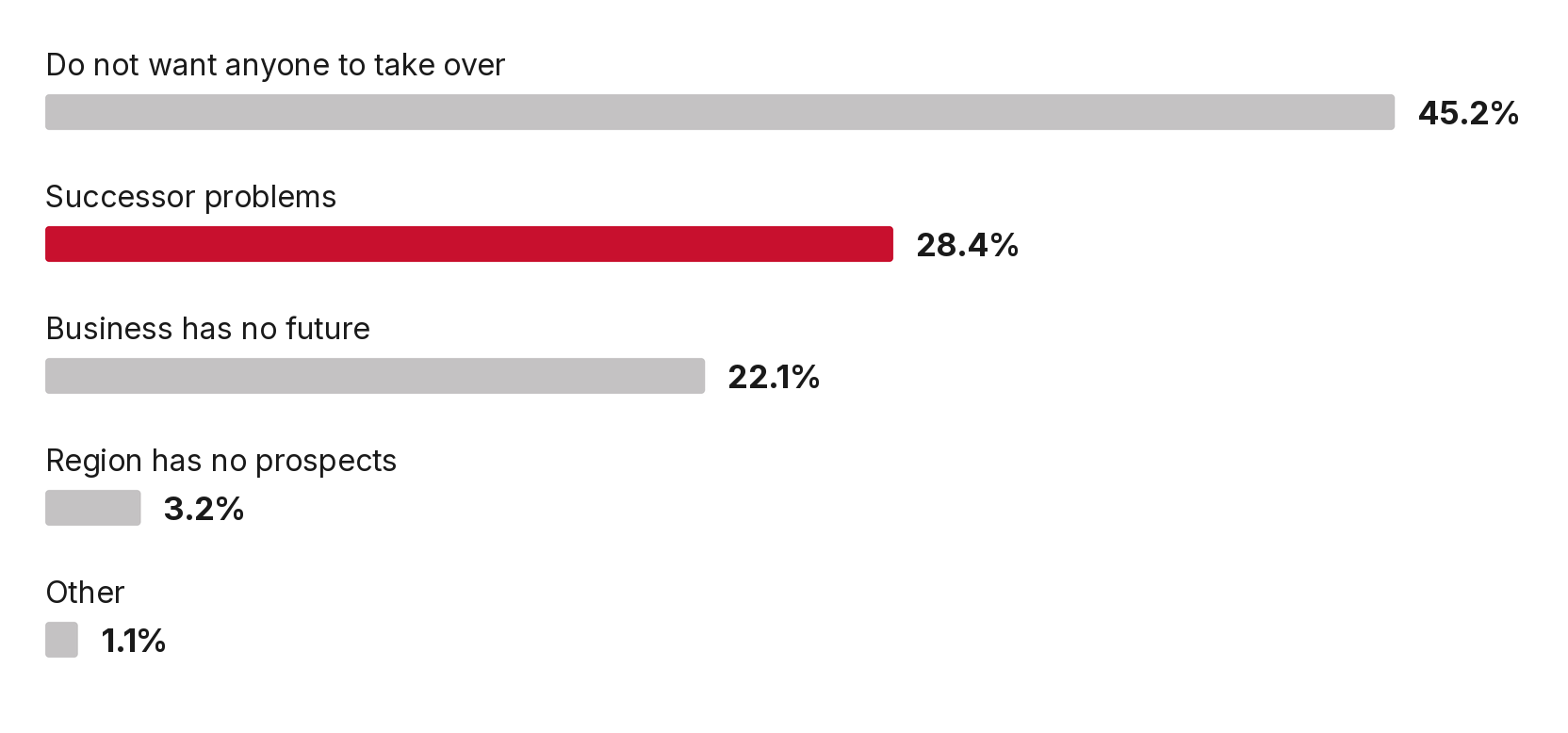
The briefing also reproduces a Japan Finance Corporation Research Institute survey (2023) of companies planning to close. Reasons: 45.2% do not want anyone to take over, 28.4% cite successor problems (no children 12.1%, children unwilling to take over 10.9%, no suitable successor found 5.4%) and 22.1% say the business has no future. The Ministry notes that the tax measure cannot address many of these.
What we take from it
The views below are ours. The measure applies to shares acquired by gift or inheritance, so it mainly serves family and employee successors; a searcher who buys shares is outside it. Until the FY2027 reform settles what follows, the 2027 dates may push owners weighing a family or in-house handover to decide on timing. On the JFC survey shown in the MOF briefing, most closing owners give reasons tax relief cannot touch.
Sources
- Ministry of Finance: Succession tax briefing, tax EBPM expert panel (9 Oct 2026) (retrieved 2026-10-23)
- National Tax Agency: Corporate succession tax leaflet (July 2026) (retrieved 2026-10-23)
- National Tax Agency: Individual-business succession tax leaflet (July 2026) (retrieved 2026-10-23)
- Miyagi Prefecture: Succession tax and financial support (updated 27 Apr 2026) (retrieved 2026-10-23)
- Kanagawa Prefecture: Succession tax for unlisted shares (updated 1 Oct 2026) (retrieved 2026-10-23)