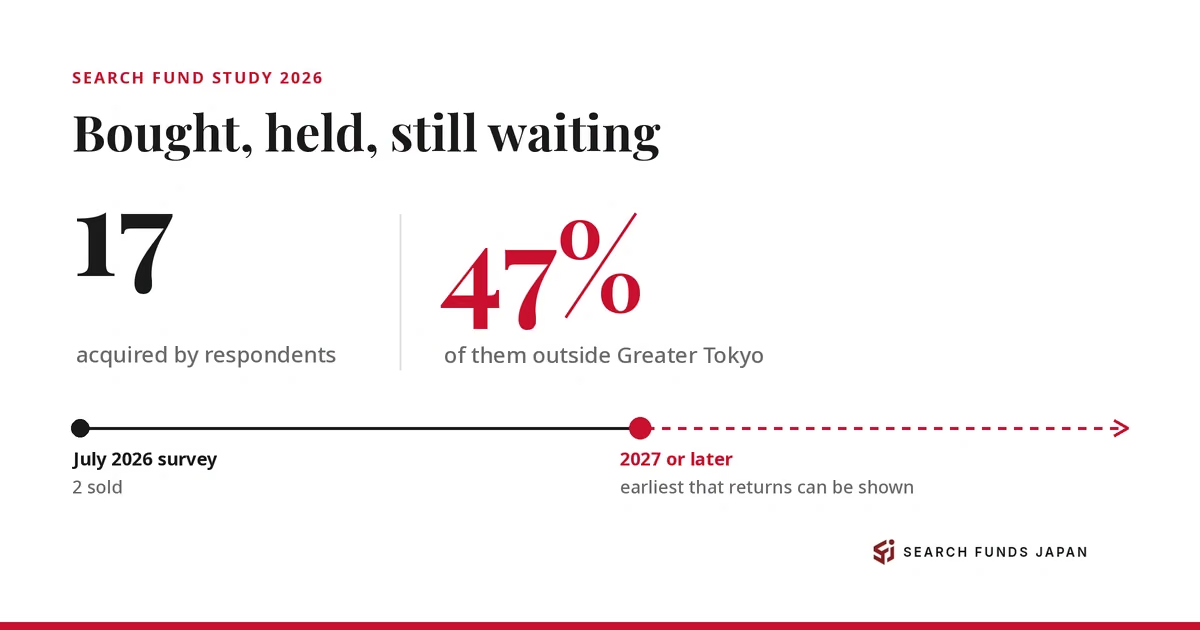
Japan now has a systematic picture of its search-fund industry. The *Search Funds Study in Japan 2026*, released publicly on 6 November 2026 by the Search Fund Association of Japan (一般社団法人日本サーチファンド協会), is based on answers from 35 search-fund entrepreneurs and 10 investors. To the best of the research team's knowledge, it is the first comprehensive primary survey in Japan to cover both groups with questions designed for comparison with the Stanford Graduate School of Business Search Fund Study and the IESE International Search Funds Study. Of the 17 companies respondents have acquired, 88% are still held and only two have been sold. The report calls the industry “before dawn”: returns will not be demonstrated until 2027 or later. The principal investigators are Hirokazu Hasegawa, a professor at Waseda Business School, and Ryukichi Miyabayashi, managing partner for Northeast Asia at IMD, who is also the lead author. The findings were presented at the Japan Search Fund Conference in July 2026, co-hosted by the association and Waseda University. This is the first edition; the authors intend to repeat the survey every two years.
The online survey ran from 3 June to 13 July 2026. The 35 entrepreneur responses cover a little over 60% of an estimated 51–58 search-fund entrepreneurs in Japan, including 15 of the 16 traditional search funds known to the association (94%) and about half of 34 known accelerator-type entrepreneurs. The investor responses cover more than 80% of the principal investors whose activity in Japan can be confirmed.
Two routes in
There is no single entrepreneur profile. Traditional searchers, who typically launch after an overseas MBA, have a median age at launch of 34.5, and 81% hold an overseas MBA. Accelerator-type searchers, who enter after longer operating experience that includes P&L responsibility, have a median age of 45, and 35% hold an overseas MBA. Overall, the median age at the start of the search is 36 (range 28–53), 71% hold an MBA, 97% are men and 3% are women (one person). In the survey sample the two types are almost even: 49% accelerator-type and 46% traditional-type, with self-funded searches and hybrids a small minority. In the known population, though, accelerator-type entrepreneurs outnumber traditional-type ones by 34 to 20, or roughly 1.7 to 1. The report treats that wider gap as a structural feature of Japan. The IESE international study (2026 edition) counts only traditional (“core”) search funds and records eight funds and four acquisitions for Japan as of the end of 2025, so the accelerator majority does not appear in those international figures.

The reasons for choosing each type are mirror images. Those who chose the traditional type cite management autonomy (94%) and conformity with the international standard (56%). Those who chose the accelerator type emphasise the content of investor support (65%) and ease of fundraising (65%).
Talent in the capital, nearly half the companies outside it
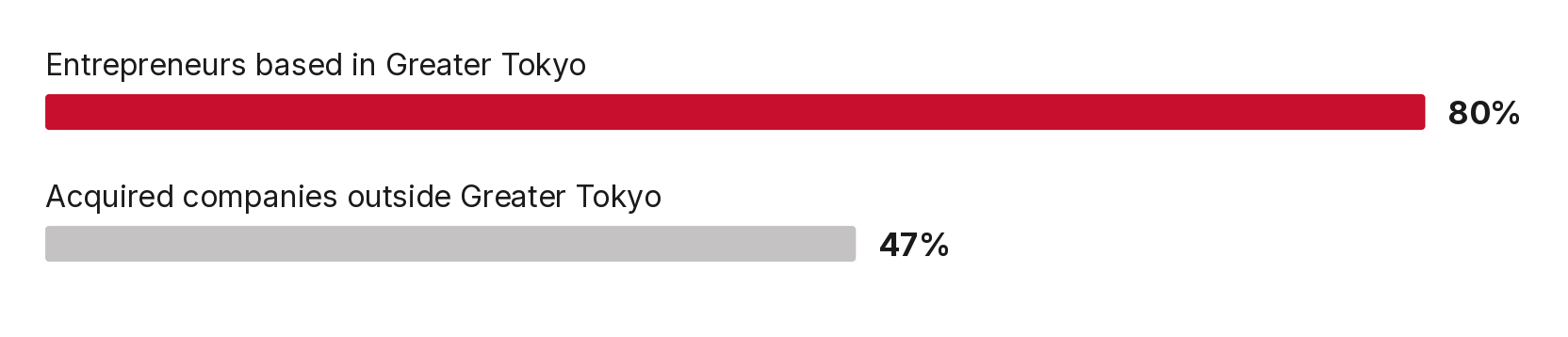
Eighty percent of entrepreneurs are based in the Greater Tokyo area (Tokyo, Saitama, Chiba and Kanagawa); Tokyo alone accounts for 77%. Of the 17 acquired companies, 53% are in Greater Tokyo and 47% are outside it (four in Kansai, three in Fukuoka and one in Mie). Tokyo itself accounts for only 35% of the acquired companies.
The companies bought are mainly succession businesses. Wholesale and retail (29%), services and IT (29%) and manufacturing (18%) predominate. Firms with 10–30 employees account for 35%, and those with 50 or more for 29%. Median annual revenue at acquisition is ¥885 million (about US$5.6 million; 12 responses, 29% missing). Sellers are founders (35%) and second-generation or later family owners (35%); 79% of sellers are aged 55 or older (14 responses). Deals were sourced through M&A intermediaries in 59% of cases and through referrals from financial institutions in 24%. 64% of acquisitions used bank borrowing (9 of 14 responses).
What investors look for
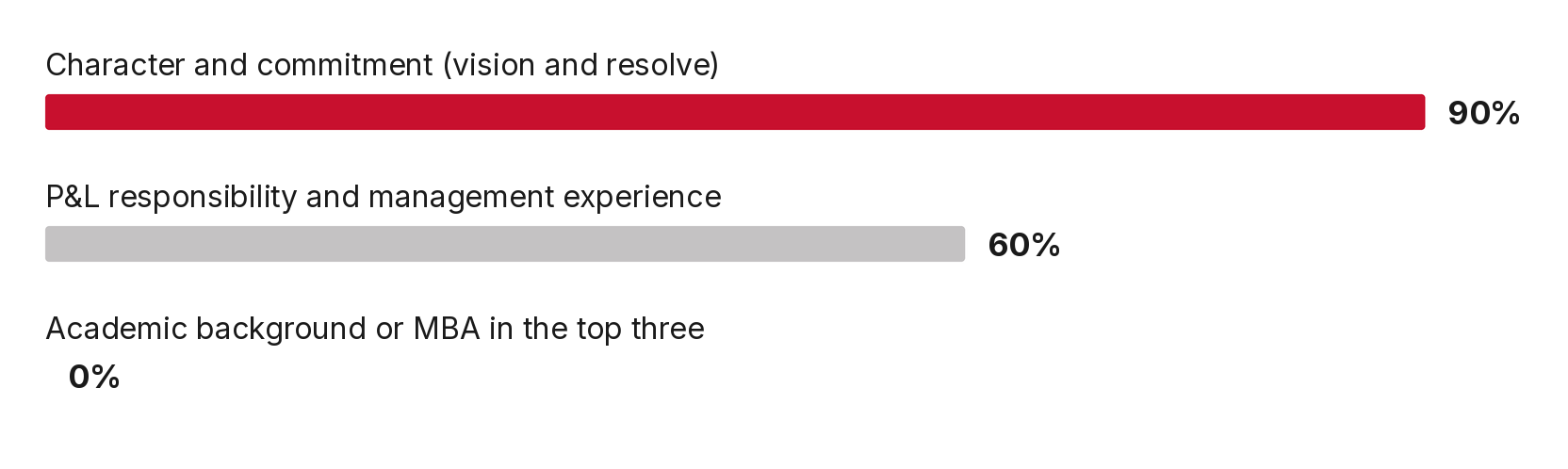
The 10 investors comprise six traditional search-fund investors (LPs) and four search accelerators. All 10 provide search capital and acquisition capital together with mentoring. In evaluating prospective search-fund entrepreneurs, the criteria weighted most heavily are character and commitment (vision and resolve), cited by 90%, and P&L responsibility and management experience (60%). No respondent ranked academic background or an MBA among the top three.
Seventeen companies, two exits
On the entrepreneur side, 88% of the 17 acquired companies are still held and 12% (two) have been sold. An exit, the report says, is the recovery of invested capital through the sale of shares in the acquired company or similar means. On the investor side, six of nine respondents (67%) have no exit track record.

The 35 entrepreneur respondents include 15 CEOs still managing an acquired company, nine people who are searching, seven who are fundraising, two CEOs who have sold the company, one former searcher whose search ended without an acquisition, and one other. For the 15 companies still held, the median year of acquisition is 2024, and 70% were acquired in 2024 or later. Applying a standard holding period of five to seven years, the report calculates that 12–13 of those 15 would reach their exit window between 2027 and 2032. Expected exit routes among CEOs still holding their companies are evenly split between sale to a strategic buyer (33%) and a management buyout (33%), with 27% undecided and 7% expecting an IPO. The two exits in the study were already recorded by 13 July 2026, when the survey closed. Since then, Search Fund Japan has sold its entire stake in Dion Tokyo, a seller of golf simulators taken over through a search fund in 2023. The deal completed on 16 October 2026.
Our reading
The views below are ours. Japan now has a baseline for tracking a young industry that has adapted the imported model to business succession and to a thin layer of institutional investors, including an accelerator path that the IESE international study does not count. The clearest pattern is geographic: management talent clustered in Greater Tokyo is taking over smaller succession companies, nearly half of them outside it. As a financial record, the study is a starting point. Two exits in the survey do not yet make a track record of returns, and the first wave of exits, which the authors expect from 2027 and see as the real test of the Japanese ecosystem, is still ahead. Owners have their own reservations: in the Japan Chamber of Commerce and Industry's 2026 succession survey, four in five older owners without a successor who want to continue have never considered M&A, and wariness of bad buyers and intermediaries ranks among their main reasons. The study's investors already rank character and commitment far above credentials. What the industry still has to build, as our report on the successor gap also noted, is trust.
Sources
- Search Fund Association of Japan: Release of Search Funds Study in Japan 2026 (6 Nov 2026) (retrieved 2026-11-07)
- Search Funds Study in Japan 2026 (English), Hasegawa and Miyabayashi, November 2026 (retrieved 2026-11-07)
- サーチファンド実態調査2026 (Japanese), Hasegawa and Miyabayashi, November 2026 (retrieved 2026-11-07)
- Kowalewski, Naranjo, Kelly and Simon, International Search Funds 2026: Selected Observations, IESE Business School (ST-0689-E) (retrieved 2026-11-12)
- Search Fund Japan: Share transfer of Dion Tokyo (20 Oct 2026) (retrieved 2026-11-12)
- Dion Tokyo: Capital partnership and change of shareholders (20 Oct 2026) (retrieved 2026-11-12)
- Yokohama Capital: Capital partnership with Dion Tokyo (20 Oct 2026) (retrieved 2026-11-12)