Five people will pitch on 20 November for businesses they hope to take over. Two are in the Chubu region: a long-established manufacturing firm and a group-home business for people with disabilities. Three are in the Kanto region: a packaging-materials manufacturer, a private-lodging (minpaku) business and a real-estate brokerage and rental-management company. TRANBI, the business-succession and M&A marketplace, chose them from 14 participants in the first edition of its practical succession programme, 継キャリ QUEST'26. Due diligence, negotiations over deal terms, fundraising and closings are planned from December 2026 to February 2027.
The programme
継キャリ QUEST is a free, practical programme run by TRANBI. Participants search among businesses listed on the platform, meet owners and negotiate. Those who win a pitch receive a grant toward the succession. Mentors from TRANBI's user community, people with succession or management experience, accompany them from the search through management after a closing.
The programme is part of TRANBI's 継キャリ推進プロジェクト (succession-career project), which started on 9 October 2025 with Waseda Business School professor Akie Iriyama and Hosei University professor Kennosuke Tanaka. The accounting software company freee and the crowdfunding company CAMPFIRE joined as partners when QUEST opened.
TRANBI began taking applications on 9 July 2026. The original deadline of 31 July was later extended to 23:59 on 9 August. Anyone with the will to take over a business could apply, as an individual or a company, with no restriction on age, experience or sector. A second-round online interview and attendance at the final pitch were required. TRANBI's official note introducing the selected participants, published on 30 September, calls this a first attempt and says 39 people applied, 26 reached the online interview, and 14 were chosen.
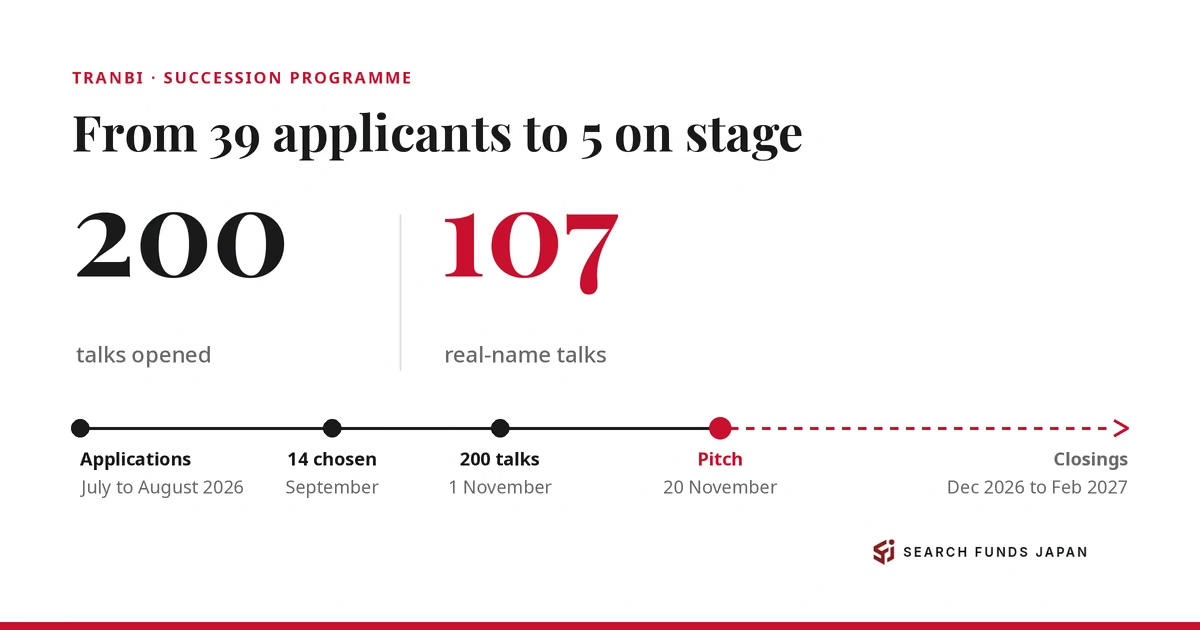
Applications and the first two review rounds ran through July and August. Mentoring and deal search filled September and October. The final pitch is on 20 November. After that, due diligence, negotiations over deal terms, fundraising and closing are planned, then a report meeting and management mentoring from March. TRANBI says support for all 14 participants, including those who do not pitch on 20 November, will continue after the event, toward a closing and after it.
Three winners will receive a total of ¥5 million in succession support. At launch, TRANBI said the money is not equity or a loan, and is in principle not repayable, though it can be clawed back in cases set out in the rules, such as misconduct or an early resale after closing. Separate conditions apply, TRANBI said. A 21 October notice to people who wanted to watch the pitch said the grant can be applied toward acquisition funds. Partner prizes, the "freee award" and the "CAMPFIRE award", were described at launch as a year of freee's accounting software and support for a CAMPFIRE crowdfunding campaign.
TRANBI says the platform has more than 240,000 registered users, of whom about 70% are individuals, and that cumulative closings have passed 2,400. Teikoku Databank put the 2025 nationwide rate of companies with no successor at 50.1%, and counted 503 bankruptcies in 2025 from a lack of a successor, the third straight year above 500.
From applications to real-name negotiations
From September the 14 participants, with mentors, searched listings on TRANBI and met owners. By 1 November they had started 200 negotiations, of which 107 had reached what TRANBI calls "real-name negotiation": buyer and seller disclose their names to each other and begin a more concrete discussion. TRANBI says the five finalists are those whose negotiations have actually moved forward, and who have formed a concrete plan for how the business would grow after they take it over.

Who will pitch
TRANBI describes the five, in Japanese syllabic order, and the businesses they plan to present, as follows. The names of the target businesses were not published.
- Koike Taishi (小池 泰志), in his 20s, president of Aogiri Inc., who has experience opening and running disability-welfare facilities and developing software in that field. Planned pitch: a group-home business for people with disabilities in the Chubu region.
- Toyohara Yuna (豊原 由奈), in her 30s, an HR professional at a startup, with experience in corporate sales, new business and a head-of-HR role. Planned pitch: a long-established manufacturing firm in the Chubu region.
- Nishimura Kohei (西村 康平), in his 30s, president of Hero Produce Inc., with experience in M&A intermediation and in management after a succession. Planned pitch: a packaging-materials manufacturer in the Kanto region.
- Hiasa Sachiko (日朝 幸子), in her 40s, a sole proprietor, who previously worked on lodging reservations, new business and international operations at a booking-service company, and now helps companies form and launch businesses. Planned pitch: a private-lodging (minpaku) business in the Kanto region.
- Yoshikawa Hayata (吉川 隼大), in his 30s, president of Playbackers Inc., an entrepreneur based in Chiba who works on unused real estate and local-business regeneration, including the revival and operation of a campsite. Planned pitch: a real-estate brokerage and rental-management company in the Kanto region.
How to watch on 20 November
The pitch is at 14:00 on Friday, 20 November 2026, at freee's Osaki office in Shinagawa, and will be streamed online at the same time. It is free with advance registration. Details are on TRANBI's event page and the programme site.
The judges are Akie Iriyama, professor at Waseda Business School (management); Satoshi Kawanishi, freee's executive officer and CBDO (management and financial foundations); Hiroyuki Oshima, executive officer and CFO of CAMPFIRE (funding and building a base of supporters); and Satoshi Takahashi, TRANBI's president and CEO (the organiser's practical view). TRANBI says the winners and the amounts of succession support will be announced at the event. A talk session, including participants who are not pitching, is also scheduled, on the challenges they faced over the past three months and the sense of progress they felt.
Our reading
継キャリ QUEST sits beside search funds as another way for individuals, and for people who already run small companies, to try to buy a business in Japan. In a typical search fund, the searcher first raises search capital to fund the search, then raises acquisition capital separately once a target is found. Search investors usually have a right to invest in the deal. QUEST starts from TRANBI's public marketplace, and applicants need only the intent to take over a business. Each of the five will present at the final pitch a growth plan for the business they hope to take over, developed with support from mentors.
TRANBI's count is of negotiations started. Some may involve the same business, and it does not count closings.
The grant is modest. It can help with costs, or with part of a small purchase, but it is not by itself the capital a searcher would usually take into an acquisition. The test is whether any of the 14 reach a closing in that December-to-February window, and how they manage the business afterwards. Those results are not yet public.
For searchers, 20 November is a rare open look at how this kind of buyer presents a growth plan in public, and at the challenges they faced and the sense of progress they felt, as described in the talk session. The individual-buyer route is already a real channel on Japanese marketplaces. Whether QUEST turns that activity into completed successions is the part to watch after the event.
Sources
- TRANBI: five finalists named for the 継キャリ QUEST'26 final pitch (PR Times, 11 November 2026) (retrieved 2026-11-11)
- TRANBI: 継キャリ QUEST programme page (retrieved 2026-11-11)
- TRANBI: launch of 継キャリ QUEST and opening of applications (PR Times, 9 July 2026) (retrieved 2026-11-11)
- TRANBI: notice that applications have opened, including the later extension of the deadline to 9 August (retrieved 2026-11-11)
- TRANBI: final-pitch spectator notice and event page (21 October 2026) (retrieved 2026-11-11)
- TRANBI official note: introduction of QUEST'26 participants, vol. 1 (30 September 2026), for the 39 applicants and 26 second-round interviews (retrieved 2026-11-11)
- TRANBI: launch of the 継キャリ推進プロジェクト (PR Times, 9 October 2025) (retrieved 2026-11-11)
- Teikoku Databank: 2025 nationwide survey of companies with no successor (21 November 2025) (retrieved 2026-11-11)
- Teikoku Databank: 2025 bankruptcy annual report (13 January 2026) (retrieved 2026-11-11)