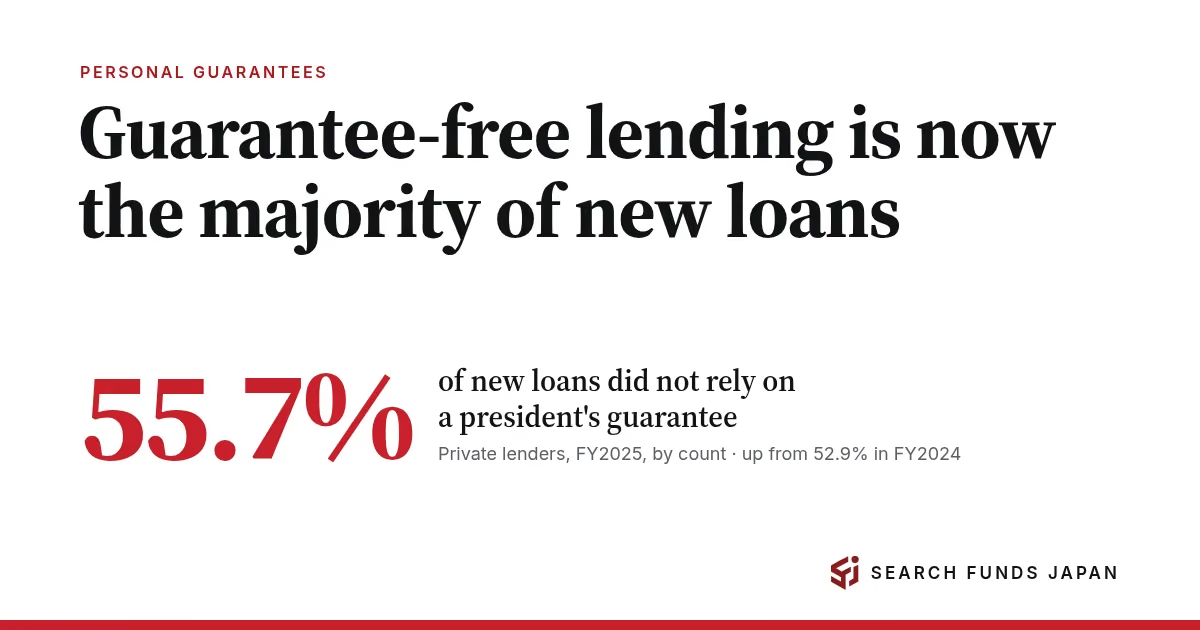
The Financial Services Agency (FSA) reports that 55.7% of new loans made by Japan's private financial institutions in fiscal 2025 did not rely on a personal guarantee from the company's president, up from 52.9% a year earlier. The FSA release of 26 June 2026 covers 529 institutions: banks, shinkin banks and credit unions. For succession, the more telling figures sit in a second table: when a company's president changed, the previous president's guarantee often stayed in place.
Guarantee-free lending is now the majority
The FSA counts a loan as guarantee-independent when it carries no guarantee, or an alternative such as a conditional guarantee contract or asset-based lending. That share was 12.2% in FY2015 and has risen every year: 14.4%, 16.5%, 19.2%, 21.6%, 27.6%, 30.7%, 33.9%, 47.6%, 52.9% and, in FY2025, 55.7%. Adding loans where a guarantee was taken but the lender explained why and recorded it, coverage reaches 99.9% of new loans. The FSA notes that these are current tallies and may change after further checks.

What happens to the old guarantee at a handover
The same release shows what lenders did when they learned that a company whose president had guaranteed its debt had changed its representative. FY2025 had 40,170 such cases (our sum of the four published counts):
- Old guarantee released, successor gives one: 16,304 cases (40.6%).
- Old guarantee kept, no guarantee from the successor: 15,932 cases (39.7%).
- Old guarantee released, no guarantee from the successor: 6,710 cases (16.7%).
- Old guarantee kept and successor gives one too (double collection): 1,224 cases (3.0%).
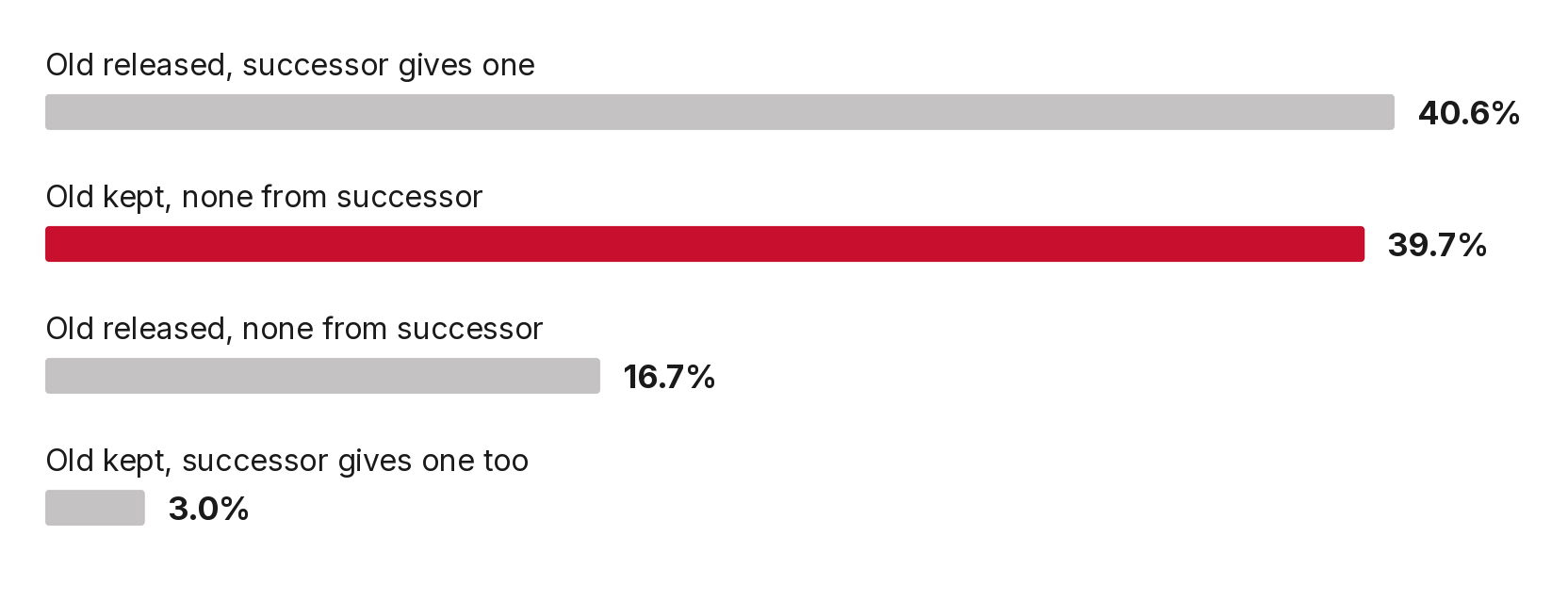
The two rows where the old guarantee was not released (kept with no guarantee from the successor, 15,932; kept and successor gives one too, 1,224) add up to 17,156 cases, or 42.7%, where the previous president's guarantee was not released (our arithmetic). Double collection has fallen from 36.9% of cases in FY2017 to 3.0% in FY2025.
New rules and a new channel in 2026
- Supervisory guidelines, in force 1 April 2026. Announced on 20 February 2026 after 14 public comments, the amendment summary tells supervisors to look for lenders that encourage early consultation on guarantees in M&A and succession and support customers up to the final agreement. Individual guarantees signed in or before March 2023 are now treated like new ones: lenders are expected to explain and record why the guarantee is needed and what would make its release more likely. The FSA says it expects lenders to do this as far as their resources allow. Root guarantees from that period were already covered.
- Background rules. The guideline study group published a special provision on succession on 24 December 2019. The FSA also notes that the 2024 SME M&A Guideline (3rd edition) lists guarantee handling as a risk, and that disputes still arise.
- Information network, open since 1 May 2026. Presidents, successors, lenders and credit guarantee corporations can submit a consultation sheet; with the consent of the parties concerned, the situation is shared, via the authorities, with the lenders or credit guarantee corporations involved. The network page says it does not mediate and does not promise that any guarantee will be released.
What we take from it
Our reading, not the FSA's. Guarantee-free lending is now ordinary at the loan level, but the handover is where the old practice still shows: about four in ten leadership changes in FY2025 left the previous president guaranteeing. For a searcher, who will guarantee what after closing, and whether the seller's guarantee is released or replaced, is a question to raise early with lenders and professional advisers. It says nothing about any particular company. The 2026 supervisory points and the network are new, and the data above cannot yet show whether they change outcomes.
Sources
- FSA: Use of the Guidelines on Management Guarantees, FY2025 results (26 Jun 2026) (retrieved 2026-10-23)
- FSA: FY2025 results table (PDF) (retrieved 2026-10-23)
- FSA: Supervisory guideline amendments, results of public comment (20 Feb 2026) (retrieved 2026-10-23)
- FSA: Management Guarantee Information Network for M&A and succession (1 May 2026) (retrieved 2026-10-23)
- FSA: Special provision of the Guidelines focused on succession (24 Dec 2019) (retrieved 2026-10-23)
- FSA: Use of the Guidelines, FY2015–FY2025 chart (PDF) (retrieved 2026-10-23)
- FSA: Supervisory guideline amendments, summary (PDF) (retrieved 2026-10-23)